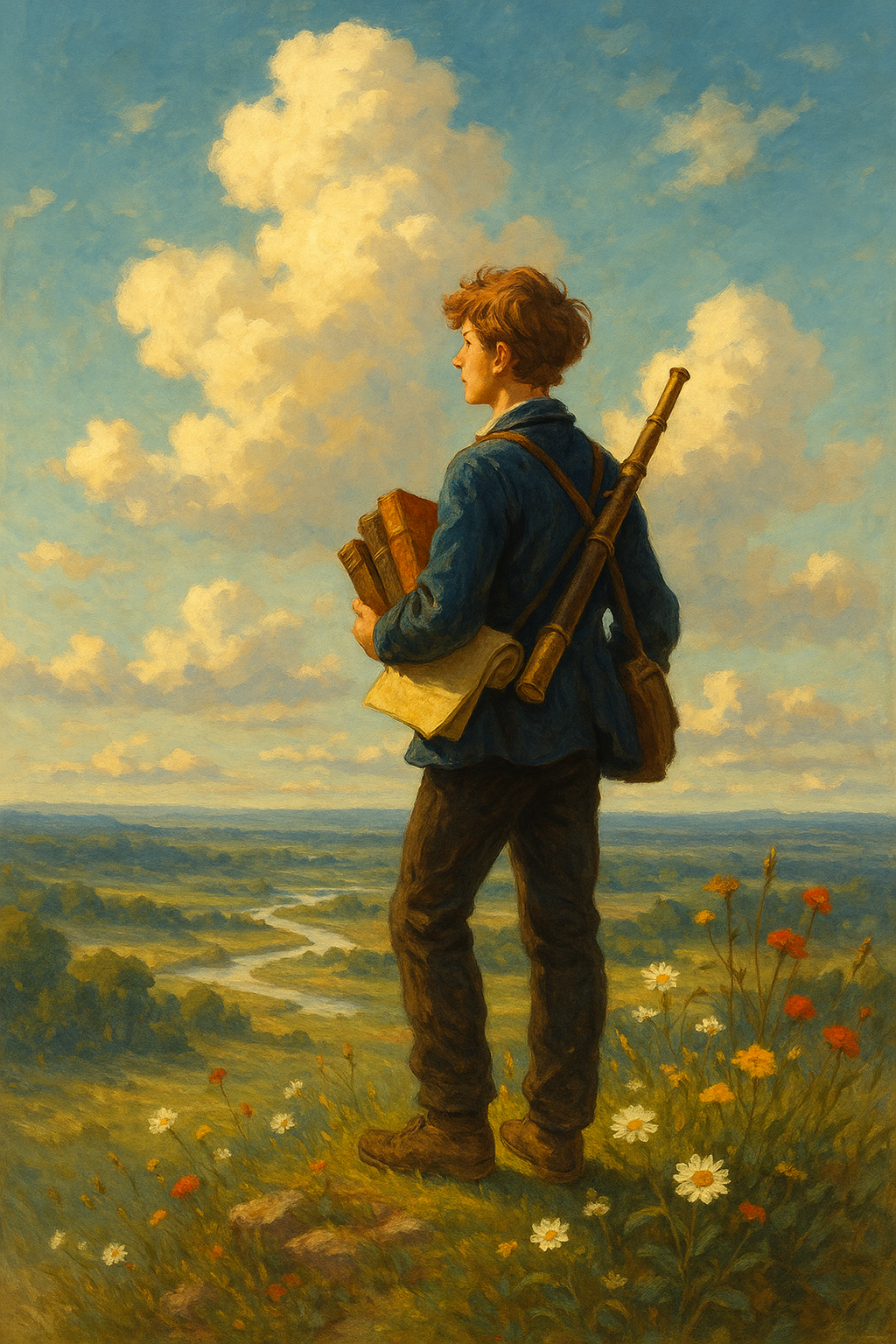
Humans weren't built to live like specialized insects. Yet that's the life modern society demands.
As I slide further into my crotchety old man era (having a kid will do that to you), I feel the urge to defend things that have fallen out of style, things we used to take for granted before we accepted our place in the machinery.
To the young man I once knew who loved to wander: this one's for you, kid.
The Original Generalists
Long before cities and kings, being a generalist wasn't a choice. It was survival. Hunter-gatherers weren't "specialized" in anything except staying alive. Everyone hunted, foraged, made tools, tended fires.
Life didn't leave room for navel-gazing. But it also didn't demand you pick one job and stick to it for life.
Fast-forward a few thousand years. Plato becomes one of the first to formally advocate for specialization: "Each man must practice one thing, that to which his nature is best adapted" (Republic, Book II, 369c). A neat idea if you're building an efficient city-state.
Here's the irony: Plato himself wrote poetry, studied mathematics and science, mastered rhetoric, then settled into philosophy. Would he have found that path without wandering first?
The Last Great Age of Wandering
Then comes the Renaissance, and here we see the opposite ideal: the well-rounded human being as a civic virtue. Leonardo da Vinci wasn't dabbling for amusement. He dissected corpses for anatomy studies, built hydraulic machines, painted some of the greatest works in history.
His curiosity about human anatomy informed his art. His engineering studies shaped his understanding of proportion. His wandering mind didn't dilute his genius. It created it.
This was the last great age where breadth was considered noble.
But within a century, curiosity itself had soured into performance.
By the 17th century, the word dilettante appears, already tainted. Italian aristocrats took passing interests in painting or music as social performance, not genuine discovery. Curiosity became something to sneer at.
Then came the Industrial Revolution and Frederick Taylor's "scientific management." Work became tiny, measured motions optimized for profit. Efficiency became the highest virtue. Curiosity was relegated to hobby status.
The Cost of Our Specialized World
We're still living in that world, and it's costing us dearly. Innovation happens at the intersections—when someone brings insights from one field into another. But our hyper-specialized culture actively discourages this kind of cross-pollination.
We've created a generation of experts who know more and more about less and less. Meanwhile, the biggest challenges we face require exactly the kind of broad, integrative thinking that specialization kills.
In Defense of the Wandering Mind
Which brings me back to Heinlein: "Specialization is for insects." Humans didn't survive the ice age by being hyper-specialized, and we didn't paint the Sistine Chapel by staying in our lane. We wander, we poke at things, we learn for the sheer hell of it.
A dilettante isn't someone who fails to master everything they try. They're someone who refuses to give up the act of creative exploration. That wandering of the mind used to be a virtue. It should be again.
Be a dilettante.
Or as Robert A. Heinlein put it in Time Enough for Love (1973): A human being should be able to change a diaper, plan an invasion, butcher a hog, conn a ship, design a building, write a sonnet, balance accounts, build a wall, set a bone, comfort the dying, take orders, give orders, cooperate, act alone, solve equations, analyze a new problem, pitch manure, program a computer, cook a tasty meal, fight efficiently, die gallantly.
Specialization is for insects.
Discussion
Forum-style discussion. Keep it thoughtful; hate speech and harassment are removed. No trackers — only an essential first-party cookie for commenting.
Loading comments…